
Material Selection Difference Between EVA and EPDM Foam | Industrial Professional Guide
In working scenarios such as industrial sealing, equipment shock absorption, outdoor supporting facilities, cabinet waterproofing, flame retardant protection, and packaging buffering, most engineering procurement and equipment operation & maintenance personnel are prone to confusing the core performance differences between EVA foam and EPDM closed-cell foam. Many purchasers select materials blindly based solely on price, ignoring the adaptation logic of material properties including temperature resistance, waterproofing, weather resistance, flame retardancy and buffering performance. This ultimately leads to common problems such as sealing water leakage, high-temperature softening, outdoor aging and cracking, damping collapse, and substandard flame retardancy, which greatly increase costs for equipment maintenance, consumable replacement and project rectification. Fundamentally, the core selection logic for distinguishing EVA and EPDM materials is not well mastered. These two foam rubber substrates have huge differences in working condition adaptability, and material mismatch will directly cause equipment failures and project acceptance failures.
1. Performance Characteristics and Application Scenarios of EVA Foam
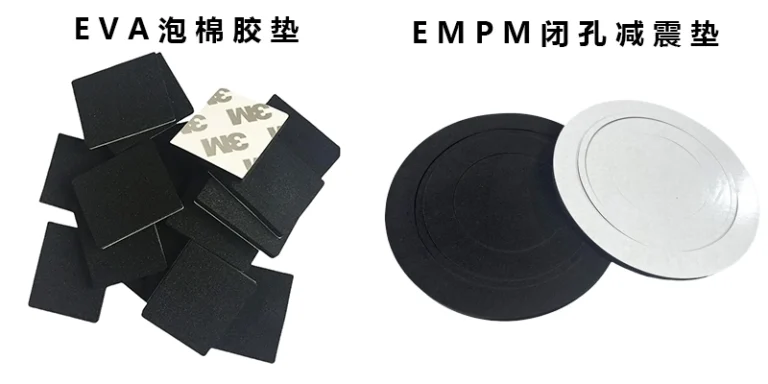
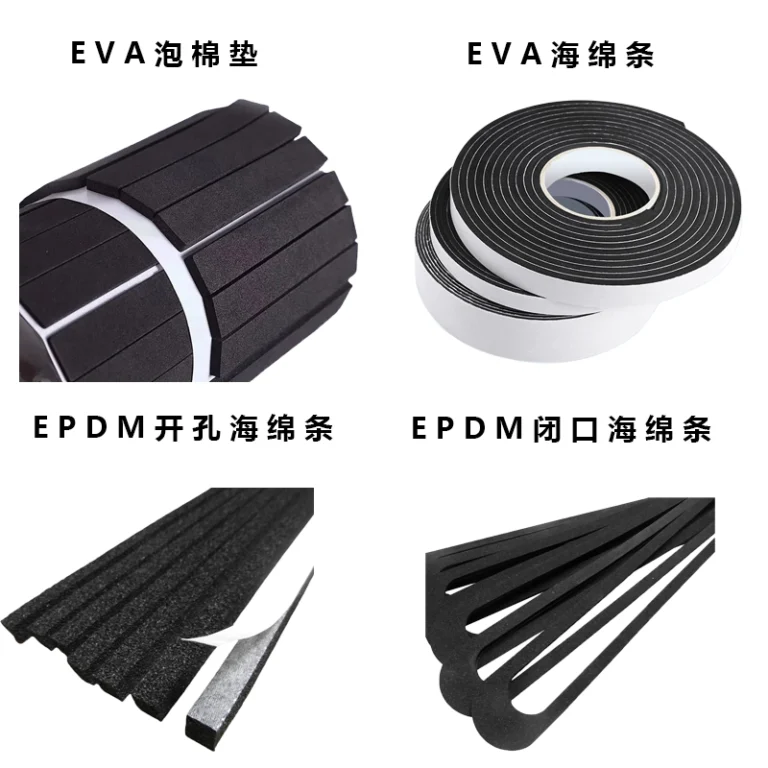
As a mainstream substrate for indoor industrial supporting applications, EVA foam includes segmented categories such as high-elastic buffer EVA foam, waterproof and shockproof EVA foam, self-adhesive backed EVA lining foam, flame-retardant and anti-static EVA foam, integrally molded CNC carved EVA lining, and furniture silent EVA foot pads. Featuring light weight, convenient cutting and high cost performance, the material has a conventional temperature resistance range of -20℃ to 80℃, with balanced waterproof, moisture-proof, compression and buffering properties, making it suitable for various indoor normal-temperature working conditions.
It is widely applied in home appliance inner protection, industrial equipment buffer gaskets, product packaging shockproofing, furniture anti-slip and silent treatment, indoor cabinet sealing, and ordinary flame retardant supporting scenarios. It can be compounded and die-cut with XPE foam, IXPE foam, EPE pearl cotton and EPP foam to produce integrated multi-layer protective liners, and supports deep processing technologies including CNC precision carving, self-adhesive die cutting and slitting slicing. With sufficient in-stock inventory, the factory supports small-batch sample testing and large-batch mass production orders to meet the normalized supporting demands of enterprises.
However, EVA foam has obvious limitations in practical application. Ordinary EVA materials have poor high-temperature resistance and ultraviolet resistance, and are prone to yellowing and brittle cracking under long-term outdoor sun exposure and rain erosion. They tend to soften and deform under oily or continuous high-temperature working conditions, losing their sealing and buffering performance. Therefore, they are completely inapplicable to harsh scenarios such as outdoor equipment, high-temperature air ducts and outdoor projects, and are only suitable for indoor normal-temperature static and light-load dynamic working conditions.
2. Performance Characteristics and Application Scenarios of EPDM Foam
EPDM foam is divided into two major categories: open-cell EPDM foam and closed-cell EPDM foam. Its core products include waterproof and shockproof closed-cell EPDM foam and weather-resistant sealed EPDM foam, which are special foam rubber materials for industrial outdoor, high-temperature and weather-resistant working conditions. It boasts a temperature resistance range of -40℃ to 120℃, with excellent ozone resistance, ultraviolet resistance, acid and alkali resistance, and oil resistance. It can be used outdoors stably for more than five years without aging, cracking, falling off or failure.
Closed-cell EPDM features extremely low water absorption and outstanding waterproof and sealing performance, specially adapted for high-standard working conditions such as outdoor equipment sealing, open-air cabinet waterproofing, high-temperature pipeline heat insulation and construction machinery shock absorption. Open-cell EPDM is equipped with interconnected pores, delivering excellent air permeability and sound absorption effects. It is applicable to computer room sound insulation and equipment ventilation buffering, and is often combined with polyurethane filter cotton, needle-punched cotton and hot-air cotton to form complete sets of industrial ventilation and noise reduction consumables.
3. Factory Customization and One-stop Supporting Advantages
Most small manufacturers on the market can only supply fixed-specification plates and fail to adjust foam density, hardness and flame retardant grades according to actual working conditions. The lack of customization capability easily leads to inappropriate material selection and adaptation deviation. As a professional source foam rubber manufacturing factory, we independently mass-produce a full range of EVA foam and open/closed-cell EPDM foam, and provide auxiliary foam materials including CR rubber foam, NBR slow-rebound foam, SBR rubber foam, TPU foam and PVC foam, realizing one-stop supply of industrial foam rubber consumables.
Equipped with complete independent production lines for foaming, compounding, die cutting and CNC precision carving, the factory supports customized processes such as self-adhesive backing, integral molding carving, special-shaped die cutting, multi-layer compounding and precision cutting. We can customize various sealing gaskets, protective liners and shock-absorbing gaskets according to customer drawings and physical samples. Professional engineers provide one-on-one working condition selection solutions to accurately match different demands for indoor and outdoor use, high and low temperature resistance, mute effect and sealing performance. This thoroughly solves the material selection dilemma between EVA and EPDM, and avoids material mismatch, consumable waste and equipment rework from the source.
4. FAQ About EVA and EPDM Foam Selection
What is the biggest difference between EVA foam and EPDM foam?
The core difference lies in weather resistance and temperature resistance. EVA foam is only suitable for indoor normal temperature environments with poor UV and high-temperature resistance. EPDM foam features excellent high and low temperature resistance, UV resistance and aging resistance, which is the preferred material for outdoor and high-temperature industrial working conditions.
Can EVA foam be used for outdoor projects?
No. Ordinary EVA foam will turn yellow, crack and age rapidly under outdoor sun exposure and rain erosion, and cannot meet long-term outdoor use standards. Outdoor scenarios must choose closed-cell EPDM foam.
What scenarios is open-cell EPDM foam suitable for?
Open-cell EPDM foam has good air permeability and sound absorption, mainly used for indoor and outdoor equipment ventilation, computer room sound insulation, noise reduction buffering, and supporting industrial dust removal and ventilation systems.
Can customized processing of EVA and EPDM foam be supported?
Yes. We support full custom processing including die cutting, CNC precision carving, adhesive backing, multi-layer composite and special-shaped cutting, and can customize products according to drawings and samples for different industrial working conditions.