
How to Select Air Purification Filter Cotton? Comparison of Three Material Types | Professional Guide
In scenarios including industrial workshop waste gas treatment, factory fresh air ventilation, commercial HVAC purification, whole-house formaldehyde removal for homes, and closed equipment air duct filtration, most purchasers and equipment suppliers face difficulties in filter material selection. Traditional activated carbon filter cotton relies solely on physical adsorption with single functionality. It easily reaches adsorption saturation and causes secondary odor desorption and rebound, resulting in greatly attenuated purification effects after long-term use and failing to meet diverse air treatment demands.
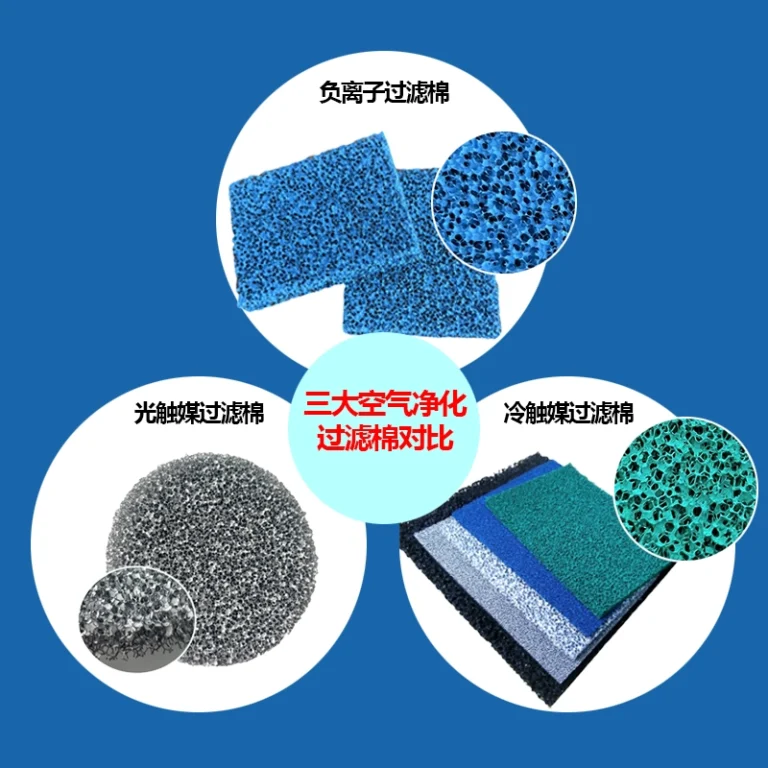
Negative ion, photocatalyst and cold catalyst filter cotton are mainstream new functional purification filter materials. They adapt to segmented scenarios such as fresh air ventilation, photocatalytic degradation, and light-free closed environments, and are widely applied for air optimization in industrial, commercial and household fields. Zhongke Foam focuses on the customized production of air purification filter cotton supporting multi-industry equipment. This article compares material characteristics, functional differences, scenario adaptation and selection pitfalls to help users accurately match dedicated filter materials for specific working conditions.
1. Negative Ion Filter Cotton: Active Purification Material
Made of high-quality breathable fiber substrate compounded with eco-friendly negative ion powder through precision processing, negative ion filter cotton can continuously release negative ions to optimize air quality without external power supply. Featuring uniform pores, excellent air permeability and extremely low wind resistance, it brings no operational burden to purification equipment. It effectively intercepts dust and fine particulate matters, neutralizes positive air ions, settles suspended pollutants and inhibits bacterial growth.
With moisture-proof and corrosion-resistant properties, the material resists dust accumulation, mildew and air duct clogging during long-term continuous operation, making it suitable for 24/7 running purification equipment. Zhongke Foam provides customized products with various thicknesses and gram weights. The substrate is flat, powder-free and performance-stable, supporting bulk supporting delivery and non-standard cutting processing.
1.1 Applicable Scenarios
Industrial Scenarios: Workshop fresh air systems, closed cabinet ventilation, factory ventilation units, assembly line dust removal equipment, commercial ventilation and purification devices.
Ideal for densely populated, long-term closed and poorly ventilated commercial and household spaces, it focuses on long-term air activation optimization and fine dust purification with simple equipment maintenance and low operating costs.
1.2 Selection Pitfalls
Prioritize substrates with evenly attached powder, stable air permeability and zero powder shedding. Inferior products suffer from rapid negative ion attenuation and powder peeling, which easily clogs equipment air ducts, shortens filter service life and increases subsequent maintenance costs.
2. Photocatalyst Filter Cotton: Photocatalytic Degradation Purification Material
Photocatalyst filter cotton takes polyester fiber and non-woven fabric as the base material loaded with nano-titanium dioxide active coating, serving as the core filter material for industrial VOCs treatment, commercial ventilation deodorization and household formaldehyde removal. Triggered by photocatalytic reactions under light irradiation, it actively decomposes harmful pollutants including formaldehyde, benzene series, TVOC, paint odor, plastic odor and lampblack, converting pollutants into water and carbon dioxide to eliminate air pollution fundamentally.
It completely solves the defects of activated carbon such as adsorption saturation, odor rebound and secondary pollution, delivering durable and stable purification performance. The flexible and tear-resistant substrate ensures unobstructed air circulation and adapts to various continuously operating purification equipment. Zhongke Foam mass-produces high-adhesion photocatalyst filter cotton with firmly fixed coating and excellent degradation performance for long-term operation of various light-type purification equipment.
2.1 Applicable Scenarios
Industrial Scenarios: Spray booth tail gas purification, injection molding workshop waste gas treatment, printing workshop air treatment, laboratory harmful gas filtration, factory ventilation deodorization.
Commercial & Household Scenarios: New house formaldehyde removal purifiers, balcony ventilation equipment, whole-house fresh air deodorization devices, commercial space light purification equipment.
It is a premium functional filter material for working conditions with sufficient light exposure.
2.2 Selection Pitfalls
Its purification performance depends entirely on light conditions, and it fails to work in light-free closed environments, so it cannot blindly replace activated carbon filter cotton. Match the substrate gram weight and coating thickness according to on-site light intensity, waste gas concentration and equipment air volume to avoid purification failure caused by mismatched selection.
3. Cold Catalyst Filter Cotton: Normal-temperature High-efficiency Formaldehyde Removal Material
Specialized for light-free closed environments, cold catalyst filter cotton triggers continuous catalytic reactions at room temperature without light or heating required. It long-term decomposes formaldehyde, indoor mildew odor, lampblack residues and organic volatile compounds with no adsorption limit and zero secondary pollutant emission. Integrating physical filtration and chemical degradation functions, it intercepts suspended impurities such as dust and floating hair, features moisture resistance and bacteriostasis, and resists fouling and mildew for long-term operation in closed equipment.
Zhongke Foam’s cold catalyst filter cotton is equipped with sufficient active ingredients and stable coating, perfectly adapting to light-free closed purification scenarios and supporting customized processing of multiple specifications.
3.1 Applicable Scenarios
Industrial Scenarios: Closed cabinet purification, light-free equipment air ducts, warehouse factory formaldehyde and odor removal, underground workshop air treatment, closed equipment ventilation filtration.
Household Scenarios: Wardrobe and shoe cabinet deodorization, basement formaldehyde removal equipment, closed study purification, storage space purification.
It is the preferred filter material for industrial and household air purification in light-free closed working conditions.
3.2 Selection Pitfalls
Inferior cold catalyst materials have low active ingredients and peeling coatings, losing purification capacity after short-term use. For industrial high-concentration waste gas conditions, it must be used with front coarse filtration to prevent dust coverage on the active layer and reduced purification efficiency.
4. Core Selection Summary of Three Filter Materials
The three functional filter materials have clear functional divisions. Blind pursuit of high-end models is unnecessary; matching the material with actual working conditions is the key.
Negative Ion Filter Cotton: Suitable for industrial factory, commercial and household fresh air ventilation spaces, focusing on air activation, dust removal and bacteriostatic purification.
Photocatalyst Filter Cotton: Applied for light-exposed scenarios, strongly degrading industrial waste gas, formaldehyde and VOC chemical odors.
Cold Catalyst Filter Cotton: Dedicated to light-free closed spaces to eliminate mildew odor and organic pollution.
Zhongke Foam’s full-range purification filter cotton can be customized according to equipment air volume, pollutant types and on-site working conditions, adapting to industrial bulk procurement, commercial equipment supporting and household purification scenarios. It effectively avoids selection errors, substandard purification and consumable waste.
What is the biggest advantage of functional filter cotton over traditional activated carbon cotton?
Traditional activated carbon filter cotton only relies on physical adsorption, which is prone to saturation and odor rebound. Negative ion, photocatalyst and cold catalyst filter cotton adopt active purification principles, which can decompose pollutants continuously without adsorption limit, effectively avoiding secondary pollution and ensuring long-term stable purification effect.
Which filter cotton is suitable for dark closed spaces such as cabinets and basements?
Cold catalyst filter cotton is the best choice. It does not require light or heating and can continuously decompose formaldehyde, mildew odor and organic pollutants in light-free closed environments, which is perfectly suitable for wardrobes, shoe cabinets, basements and unventilated closed spaces.
What filter material is used for industrial workshop VOCs and peculiar odor treatment?
Photocatalyst filter cotton is recommended for industrial workshops with sufficient light. Its strong photocatalytic degradation capacity can effectively decompose paint odor, plastic odor, TVOC and other industrial waste gases, solving the problem of workshop odor pollution fundamentally.
Which filter cotton is suitable for long-term 24h fresh air operation?
Negative ion filter cotton is the most suitable. It features low wind resistance, moisture and mildew resistance, no powder shedding, and stable performance for long-term continuous operation. It can activate air, remove dust and inhibit bacteria, meeting the long-term operation demands of fresh air systems.