
Selection Guide for Industrial Solid Foam Sealing Round Strips | Professional Industrial Guide
In industrial annular sealing scenarios, flange gap water seepage, long-term cabinet dust ingress, core body collapse after compression, and aging cracking in temperature-difference environments are the most common hidden faults in electromechanical assembly, new energy cabin operation, and outdoor equipment maintenance. Most technicians attribute these problems to tolerance fit or installation processes, while the root cause lies in the mismatch of sealing strip structure and base material.
Compared with hollow tubular foam strips and flat sealing flat strips, solid foam sealing round strips feature a homogeneous integrated structure without hollow inner cavities. They deliver more uniform radial supporting force and superior resistance to compression set, and can adapt to special-shaped sealing points such as arc flanges, annular grooves, and pipeline outer wrapping. Serving as a key elastic auxiliary material, they effectively improve equipment IP protection levels and ensure long-term stable sealing performance.
1.Core Structural Differences: Why Solid Strips Are More Suitable for Industrial Sealing
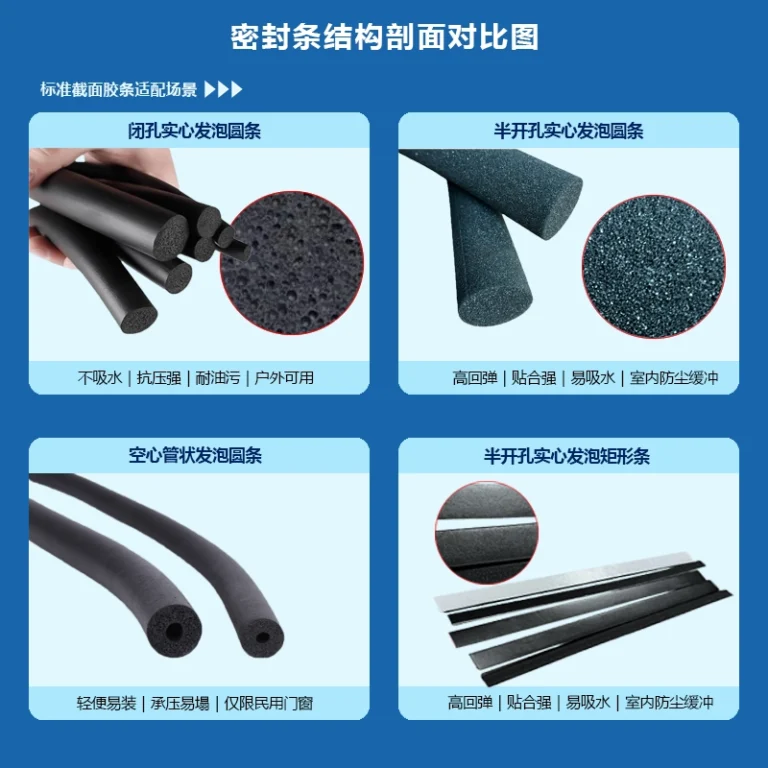
Industrial solid foam round strips are mainly divided into two structures: closed-cell solid and semi-open-cell solid, with distinct core differences from conventional hollow tubular sealing strips, and their working condition adaptation boundaries are not interchangeable.
1.1 Closed-cell Solid Structure
Features a dense surface skin, zero water absorption, high compression resistance, and excellent weather resistance. It is primarily applied to heavy-duty sealing scenarios involving outdoor waterproofing, high-pressure compression, and oil contamination contact.
1.2 Semi-open-cell Solid Structure
Adopts interconnected pores with a soft touch, high resilience, and superior fitting performance. However, it is water-absorbent by nature and only suitable for indoor low-pressure buffering and precision dustproof scenarios.
1.3 Defects of Traditional Hollow Tubular Structure
Prone to core collapse and deformation under pressure due to the hollow interior with insufficient supporting force. It is only applicable for civil doors, windows and ordinary indoor filling, and is strictly prohibited for industrial high-pressure and long-term outdoor sealing working conditions.
2. Base Material System Overview: Full Range of General and Special Rubbers
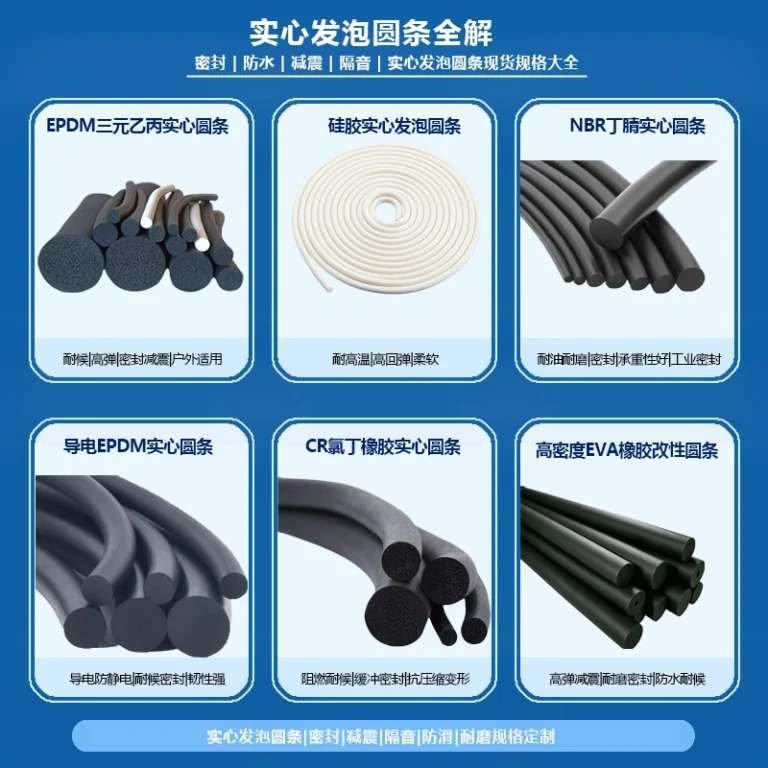
Solid foam round strips cover two major categories of base materials: general foam and special rubber, including six mainstream industrial materials that adapt to more than 95% of industrial sealing working conditions. The following section comprehensively sorts out all base materials and analyzes their performance parameters and practical applications by weather resistance, high temperature resistance, oil resistance, anti-static property, flame retardancy and heavy-load resistance for convenient selection by technical and procurement personnel.
2.1 EPDM Solid Round Strip
A weather-resistant closed-cell foam rubber material with outstanding UV and ozone aging resistance, featuring a wide temperature adaptation range of -40℃ to 120℃ and resistance to permanent deformation under long-term compression. Typical applications include flange sealing strips for outdoor electrical cabinets, annular edge sealing strips for engineering vehicle doors, plugging round strips for photovoltaic inverter cabins, and peripheral sealing strips for rail transit equipment. It is the preferred universal material for outdoor scenarios with large temperature fluctuations.
2.2 Silicone Solid Foam Round Strip
An environmentally friendly inorganic foam base material with non-toxic, insulating and physiologically inert properties, adapting to extreme temperature alternations from -50℃ to 230℃. Typical applications include warehouse pressure strips for food sterilization equipment, sealing strips for medical testing instruments, door sealing strips for industrial hot air ovens, and thermal insulation sealing strips for cold chain equipment, dedicated to high-temperature, clean and direct-contact special working conditions.
2.3 NBR Solid Round Strip
A special oil-resistant rubber base material with excellent corrosion resistance to mineral oil, hydraulic oil and oil-gas steam. It easily meets flame retardancy standards, features a dense structure and oil impermeability, and works stably within -30℃ to 105℃. Typical applications include flange sealing strips for CNC machine tool oil circuits, plugging strips for hydraulic pump station interfaces, oil isolation strips for kitchen stoves, and edge sealing strips for diesel equipment cabins, serving as the exclusive choice for fully oil-contaminated environments.
2.4 Conductive EPDM Solid Round Strip
A modified EPDM base material with precisely controlled surface resistance via conductive filler addition, while retaining the original weather resistance of EPDM. Typical applications include flange sealing strips for chemical explosion-proof cabinets, sealing strips for semiconductor material storage cabins, anti-static pressure strips for automated production lines, and isolation round strips for lithium battery workshop equipment, meeting dual requirements of outdoor weather resistance and electrostatic protection.
2.5 CR Neoprene Solid Round Strip
A universal flame-retardant rubber base material with balanced weather resistance, oil resistance and flame retardancy, excellent compression set resistance and higher mechanical strength than ordinary foam materials. Typical applications include rail transit carriage sealing strips, flame-retardant edge sealing for industrial equipment, and heavy-duty outdoor sheet metal buffer strips, focusing on flame-retardant and aging-resistant heavy-duty scenarios.
2.6 High-density EVA Modified Rubber Round Strip
A rubber-plastic blended modified base material with high hardness, strong support and anti-extrusion deformation performance, combining the toughness of rubber and the cushioning property of foam materials. Typical applications include limit plugging strips for heavy equipment, end face buffer strips for presses, and positioning sealing strips for large sheet metal, dedicated to heavy-duty limit and static high-pressure plugging scenarios.
2. Base Material System Overview: Full Range of General and Special Rubbers
Solid foam round strips cover two major categories of base materials: general foam and special rubber, including six mainstream industrial materials that adapt to more than 95% of industrial sealing working conditions. The following section comprehensively sorts out all base materials and analyzes their performance parameters and practical applications by weather resistance, high temperature resistance, oil resistance, anti-static property, flame retardancy and heavy-load resistance for convenient selection by technical and procurement personnel.
2.1 EPDM Solid Round Strip
A weather-resistant closed-cell foam rubber material with outstanding UV and ozone aging resistance, featuring a wide temperature adaptation range of -40℃ to 120℃ and resistance to permanent deformation under long-term compression. Typical applications include flange sealing strips for outdoor electrical cabinets, annular edge sealing strips for engineering vehicle doors, plugging round strips for photovoltaic inverter cabins, and peripheral sealing strips for rail transit equipment. It is the preferred universal material for outdoor scenarios with large temperature fluctuations.
2.2 Silicone Solid Foam Round Strip
An environmentally friendly inorganic foam base material with non-toxic, insulating and physiologically inert properties, adapting to extreme temperature alternations from -50℃ to 230℃. Typical applications include warehouse pressure strips for food sterilization equipment, sealing strips for medical testing instruments, door sealing strips for industrial hot air ovens, and thermal insulation sealing strips for cold chain equipment, dedicated to high-temperature, clean and direct-contact special working conditions.
2.3 NBR Solid Round Strip
A special oil-resistant rubber base material with excellent corrosion resistance to mineral oil, hydraulic oil and oil-gas steam. It easily meets flame retardancy standards, features a dense structure and oil impermeability, and works stably within -30℃ to 105℃. Typical applications include flange sealing strips for CNC machine tool oil circuits, plugging strips for hydraulic pump station interfaces, oil isolation strips for kitchen stoves, and edge sealing strips for diesel equipment cabins, serving as the exclusive choice for fully oil-contaminated environments.
2.4 Conductive EPDM Solid Round Strip
A modified EPDM base material with precisely controlled surface resistance via conductive filler addition, while retaining the original weather resistance of EPDM. Typical applications include flange sealing strips for chemical explosion-proof cabinets, sealing strips for semiconductor material storage cabins, anti-static pressure strips for automated production lines, and isolation round strips for lithium battery workshop equipment, meeting dual requirements of outdoor weather resistance and electrostatic protection.
2.5 CR Neoprene Solid Round Strip
A universal flame-retardant rubber base material with balanced weather resistance, oil resistance and flame retardancy, excellent compression set resistance and higher mechanical strength than ordinary foam materials. Typical applications include rail transit carriage sealing strips, flame-retardant edge sealing for industrial equipment, and heavy-duty outdoor sheet metal buffer strips, focusing on flame-retardant and aging-resistant heavy-duty scenarios.
2.6 High-density EVA Modified Rubber Round Strip
A rubber-plastic blended modified base material with high hardness, strong support and anti-extrusion deformation performance, combining the toughness of rubber and the cushioning property of foam materials. Typical applications include limit plugging strips for heavy equipment, end face buffer strips for presses, and positioning sealing strips for large sheet metal, dedicated to heavy-duty limit and static high-pressure plugging scenarios.
3. Cross-sectional Shapes and Adhesive Backing Properties
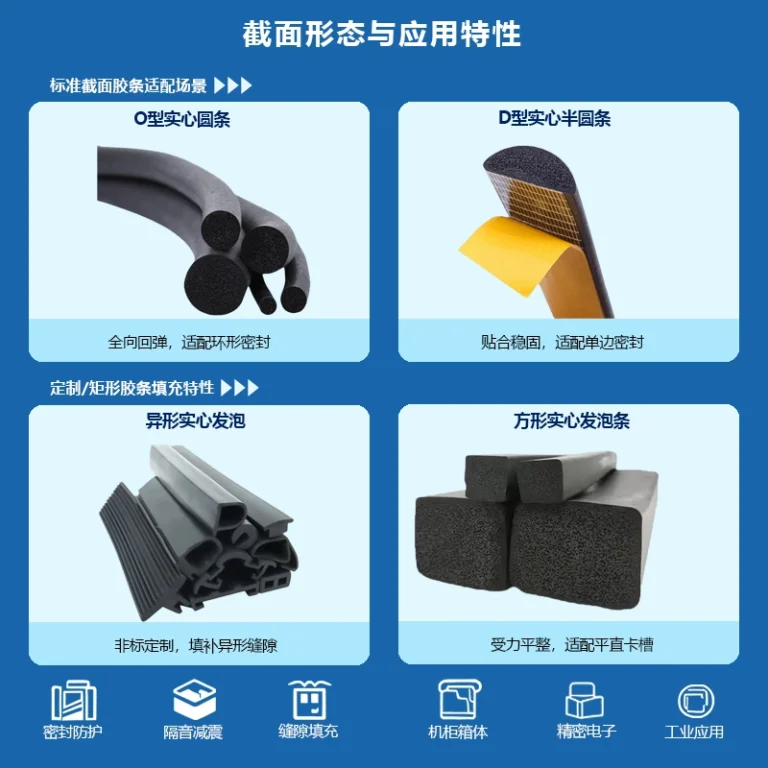
3.1 Four Major Cross-sectional Shapes and Practical Application Scenarios
① O-shaped Solid Round Strip (Perfect Circular Cross-section)
Features uniform stress in all directions and consistent radial compression resilience. As a standard universal cross-section, it adapts to closed-loop annular structures, circular grooves and circumferential compression structures. Widely applied in pipeline flange annular sealing, pressure vessel port plugging, battery pack closed-loop dustproofing, and circular access opening edge sealing. Compatible with all general and special rubber base materials, it is the most widely used standard shape in industrial applications.
② D-shaped Solid Semicircular Strip (Arched Cross-section)
Fits the base surface with its flat side and achieves pressure sealing with its arc side, balancing bonding stability and sealing resilience without rolling displacement. Ideal for flat sheet metal bonding and installation. Typical applications include single-side sealing of cabinet doors, dust and noise insulation for flat sheet metal surfaces, rainproof baffling for box side edges, and shockproof edge sealing for equipment covers. Compared with O-shaped strips, it is more suitable for open single-side non-closed assembly scenarios.
③ Special-shaped Solid Foam Strip (Irregular Cross-section)
Customized trapezoidal, eccentric circular and multi-ribbed cross-sections tailored to groove tolerances and high-low pressure differences, specifically solving sealing problems of special-shaped gaps, step surfaces and variable-width tolerance gaps. Applied to special-shaped cast aluminum shell edge sealing, step gap plugging for high and low voltage cabinets, special-shaped groove sealing for non-standard equipment, and mold positioning buffer sealing, mostly used for non-standard equipment, precision tooling and customized electromechanical structures.
④ Square Solid Foam Strip (Rectangular Cross-section)
Features a regular right-angle rectangular cross-section with flat and uniform stress surfaces and no lateral rolling risk, adapting to rectangular clamping grooves, flat flange surfaces and equal-width gap plugging with better support performance than circular cross-sections. Applied to rectangular clamping groove sealing of electrical boxes, flat flange edge sealing of cabinets, equal-width gap filling for construction equipment, and lamination plane shock absorption for sheet metal. It is one of the most commonly used standard cross-sections after O-shaped and D-shaped strips, suitable for regular groove and flat uniform-pressure sealing scenarios.
3.2 Adhesive-backed vs. Non-adhesive-backed: Installation Methods and Working Condition Differences
▶ Single-sided Adhesive-backed Type (With pressure-sensitive adhesive layer)
Advantages: No drilling or glue required, instant peel-and-stick installation for high construction efficiency. Disadvantages: High temperature and solvent resistance are limited by the adhesive layer, which is prone to aging and debonding under long-term sun exposure. Applicable Shapes: Mainly D-shaped, supplemented by O-shaped. Typical Scenarios: Temporary sealing of indoor cabinets, rapid modification and installation on sheet metal surfaces, post-installation equipment noise reduction and lightweight adhesive dustproofing. Prohibited Scenarios: Long-term outdoor sun exposure, high-temperature interfaces, and oil immersion environments.
▶ Non-adhesive-backed Bare Strip (Pure foam body)
Advantages: No hidden risk of adhesive layer aging, with temperature and medium resistance fully consistent with the base material’s service life. It can be embedded and compressed in grooves for maximum stability. Disadvantages: Requires groove limiting or external compression fixation and cannot be directly bonded. Applicable Shapes: Mainly O-shaped and customized special shapes. Typical Scenarios: Long-term outdoor flange sealing, high-temperature equipment door compression sealing, oil circuit and chemical industry plugging, and embedded groove installation for battery packs. Preferred for industrial heavy-duty and extreme working conditions.
4. On-site Rapid Material Selection Logic
No complex parameter calculation is required for on-site engineering selection. The optimal solution can be quickly determined through five dimensions: shape → adhesive backing → medium → temperature → pressure.
4.1 Shape Selection Rules
O-shaped for closed-loop annular compression; D-shaped for flat sheet metal bonding; square-shaped for regular rectangular clamping grooves; special-shaped for non-standard grooves.
4.2 Adhesive Backing Selection Rules
Adhesive-backed for rapid indoor construction; non-adhesive-backed mandatory for outdoor, high-temperature and heavy-duty scenarios.
4.3 Medium Adaptation Rules
EPDM for rainwater and UV environments; NBR for oil and gas corrosion environments; silicone for food-grade and high-temperature media; conventional closed-cell foam for ordinary dry indoor environments.
4.4 Temperature Adaptation Rules
Silicone mandatory for temperatures above 120℃; silicone or EPDM for alpine environments below -30℃.
4.5 Pressure Adaptation Rules
High-density EPDM, silicone or modified EVA for high-pressure heavy-duty flanges to prevent core collapse; CR for flame-retardant scenarios; NBR for medium-pressure conventional sealing to control costs.
5. Common Material Selection Pitfalls in Engineering Applications
Most failures of solid foam sealing strips stem from early selection errors. Four core problems should be avoided during on-site assembly and scheme design:
Shape Mismatch: O-shaped round strips tend to roll and displace on flat sheet metal; square or D-shaped strips are preferred for regular clamping grooves instead of round strips.
Adhesive Backing Mismatch: Using adhesive-backed strips in outdoor high-temperature scenarios causes premature adhesive debonding and leakage.
Material Mismatch: Using ordinary foam instead of CR in flame-retardant scenarios leads to potential equipment safety hazards.
Working Condition Mismatch: Ordinary foam materials cannot withstand long-term extreme temperature alternations.
6. Conclusion
The protection performance of solid foam sealing round strips is jointly determined by cross-sectional shape, adhesive backing attribute and base material performance. By clarifying the adaptation logic of four cross-sections (O-shaped, D-shaped, square, special-shaped) and the application boundaries of adhesive/non-adhesive installation, combining the characteristics of six base materials (EPDM, silicone, NBR, conductive EPDM, CR, modified EVA), and adopting the five-dimensional scientific selection method, engineers can fundamentally avoid failures such as displacement, debonding, collapse and leakage, and greatly improve the stability of equipment sealing.
international industrial foam material standardIndustrial Auxiliary Material Purchasing Guide: Common Pitfalls & Professional Selection Tips
Which is better, solid foam strip or hollow foam strip?
Solid foam strips have integrated homogeneous structure, stronger support and better compression set resistance, suitable for industrial long-term sealing and high-pressure working conditions. Hollow strips are easy to collapse and only fit ordinary indoor filling scenarios.
Is adhesive-backed sealing strip suitable for outdoor use?
No. The adhesive layer will age and debond under long-term outdoor UV and high-temperature exposure. Outdoor heavy-duty sealing must use non-adhesive pure solid foam strips with embedded compression installation.
What material is best for high-temperature sealing scenarios?
Silicone solid foam round strip is the first choice for ultra-high temperature working conditions up to 230℃. For conventional high-temperature scenarios within 120℃, EPDM material is cost-effective and stable.
What material to choose for equipment oil circuit sealing?
NBR solid round strip is professionally resistant to mineral oil and hydraulic oil corrosion, which is the exclusive material for oil contamination sealing scenarios.